Dave,
A big thank you for everything, firstly your professionalism
from start to finish, I felt very confident and informed on our first
telcons, by the questions asked, by the care shown during the all
process from booking to flying, all that for me was extremely important
as a service provider and a customer.
As for my mother and
husband, well no words can described their thrill and exhilarating joy,
they thought you gave them all the time and attention needed to make the
experience, a truly enjoyable and memorable one, they had a fantastic
time and cannot thank you enough.
Thank you
Kindest regards
Caroline, Monique & Nicholas
From Simon
Hello Dave
First chance I have had since Sunday to thank you for a
truly wonderful experience. I know I speak for Pippa too when I
say we had the most perfect day. I wouldn't rule out doing it all
over again!
Very best wishes
From Sue
Many,many thanks for the wonderful flight I had with you yesterday. I'm
still on cloud nine! A wonderful experience that i shall never forget.
I can see why you are still at it after 20 years etc...Ill be back next
summer. Happy flying and enjoy India..
Best wishes
From Lisa
Hi Dave,
I just wanted to thank you for giving Nick an amazing experience
yesterday - he had a brilliant flight and came home feeling really
exhilarated. He couldn't speak more highly of you and your knowledge
and experience. I think once the kids are a bit older he may well start
having a go himself!
Thanks again
From Tom
Hi David,
I would like to thank you for my
paragliding experience on Saturday. I totally loved the whole day, and
with the way you professionally took myself and Paul through each step,
it made us feel us totally at ease. I would definitely like to do it
again at some point but may I say that for now I have another tick in
the box for the bucket list!!
Thanks again
From Linda
Hi Dave,
No doubt you get a lot of thank you emails but.......THANK YOU !
What a fantastic flight, still playing it back in my head. Superb
piloting ! Still feeling high:-) Enjoy tomorrow.
From Sarah
Hello
Dave. We absolutely loved yesterday. The little girls have spoken of
little else! We felt entirely confident with you...what a very expert
paraglider you are! The safety briefing was so helpful. We could not
fault any part of the day!
From Justine
Dear
Dave, Mum just wanted to say a *huge thank you* for making her 70th
such a memorable and exciting day! She still has her head in the
clouds, and is recommending it to everyone, especially if they are 70
and beyond! Hope to see you again some time...... Kind Regards, Justine.
From Gary
Once
again thanks for helping me out on Sunday. It was much appreciated, I took a
look at your website and I'm sure that I will be booking an India trip
you at some point in the future.
I quickly saw that you have a gift putting across authoritative information and
advice in a non patronising way. I'm sure your 80 year old tandem flier was
happy!
Hope
to see you in the air again soon!
see Gary's excellent flying blog and photos here
From Tara
Just to say thankyou for making
Sally's birthday so memorable. She said the gliding was amazing and my
93 year old aunt, who lives in a retirement flat in Lewes, was thrilled
to have been able to watch the whole thing armed with a pair of
binoculars, from her bedroom window!! Thank you for choosing Mt Caburn!
Best wishes for continued success with your gliding and who knows we
may come back for more. Tara.
From Marlene
Dear
Dave, I just wanted to say thank you for a super day out on the 10
July. Simon had a super time (despite his initial queasiness!) as did
I! It was clear he was definitely in safe, professional hands - which
makes all the difference. Thanks again, Marlene
From Mary;
Hi
Dave. Just a quick note to thank you so much for the superb flight
yesterday - I had a wonderful time! You professionalism and skill
helped overcome my nerves and it really was fantastic to be up with the
birds and to have what we (you) were doing explained so clearly. Very
many thanks and best wishes, Mary Hart.
From parants of the blind children we flew with,
sponsored by Flyability;
Just
to let you know that last Sunday's paragliding with Skylarks was
fantastic for Christopher. I've rarely seen him so exhilarated after an
event, and he's talked about it all week. Even with help from SAVI, I
doubt we could have afforded the day without the funding from
Flyability, as it is expensive and we also had to pay our train fares
to the venue. Flyability have to be praised for giving disabled
children the opportunity to do something really adventurous, when
throughout their lives they have often had to exclude themselves (or
have been excluded) from regular sports, due to their
conditions/disabilities. Not many children of Chris's age (13), no
matter how fortunate, can say they have been up on a paraglider -
there's been much showing off at home and school!! Good for his
street-cred! Please pass on our grateful thanks to Flyability for this
wonderful opportunity.
Regards, Jennifer Russell.
I
just wanted to pass on my thanks to your charity for funding my son
Joshua's tandem paraglider flight a couple of weekends ago. He went
along with a group of other visually impaired young people to fly in
Sussex and had a wonderful day. He is now counting the days until he is
17 (he's only 11 so has quite a wait!) so that he can go back and try
the flight with acrobatics! We will certainly be going back for him to
have another go at tandem flying in the meantime. We are really
grateful to Flyability for giving him the opportunity to gain the
sensation of "flying". Keep up the good work!
Kind regards, Clare Black (Joshua's mother)
From Dom and Wendy;
Hi
Dave, Wow, wow and wow. we are still floating after our tandem
paraglide with you yesterday and truly believe that paragliding is
something everyone should experience at least once in their lives. Here
are the links to the trailguru routes so you can see the flight path we
took. it is a nifty little site; links gone dud, sorry.
We have not had a chance to get the video from the phone yet, but as
soon as it is online we will let you know. Thanks again! Fantastic! Dom
& Wendy
From Pat;
Dear Dave.
Thank
you for a terrific time today, Thank you for being sensitive to my
nervousness and making it a gentle flight. It has whetted my appetite
so maybe I'll come again and be a bit more adventurous. Thank you
again. Pat
This summer my aunt called my bluff and came
paragliding. Read what she wrote for her staff magazine:
Up up and away …..
I had a chance to meet up with my nephew last Christmas
after a gap of
some years. He is now in business on his own – and to some extent
pursuing his dream. Instead of being a wage slave he now runs a
paragliding school flying off the Sussex downs.
His parting gift was a flight invitation for a trip on
his 2-seater paraglider. Dream-on thought I.
But
the summer came, and the ideas of really doing it grew with the
(admittedly occasional) sunshine. ‘Why would I want to?’ increasingly
became ‘why not?’. Then ‘why not’ became ‘when?’. We fixed a date in
July, but then the wind and rain blew yet again and we had to call it
off. But I was now fully committed to flying with the birds.
By
the end of September we had another weekend – wind speed under 15 mph,
said the Met office, with wind from the North East, which meant
suitable downland to launch from. Saturday morning I strolled
nonchalantly onto the hill to meet David only to be greeted by a 50
foot wing coming towards me over the hill, with him and his earlier
customer hanging below. Then they swooped away, tried some aerobatics,
before coming in for a fairly controlled landing along the ridge. Gulp!
Thirty
minutes later I was adjusting the harness and going through my drill
for take off and landing. Going tandem clearly required the key skill
of obedience. Orders would be shouted in my ear from my pilot right
behind me in this mesh of webbing and clips. Having recently tried my
hand at abseiling (maximum adrenalin despite the safety ropes) this all
seemed safer somehow - but what has logic got to do with it? Next
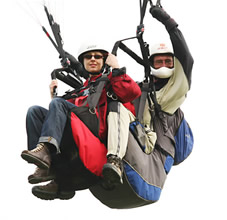
moment, there was a full arc of ripstop wing behind me beginning to
fill with the wind and tug through the myriad fine strings. Then a
sudden gust, an almighty yank on the harness and we were 20 feet up and
rising away from the hill out over open fields. The most challenging
manoeuvre for me was wriggling back to adjust the harness into a seat –
and remembering to breathe!
From there it
was pure exhilarating joy. David had an altimeter that bleeped going up
and hummed coming down; it became a companionable sound. He kept
talking and I began to see how he could read this invisible environment
of air uplifts and thermals. We watched the landscape for ripples
building across a line of trees towards the hill, and as they broke
away we swooped towards them to catch the edge of the thermal, swirling
up 4 or 500 feet. We spotted a group of jackdaws cruising on the
uplift, and traversed the ridge edge to join them. Looking down you
could see detail in the landscape that told of its archaeology. Looking
up we could fly towards a break in the clouds just big enough for a
pair of sailor’s trousers.
David regaled
me with tales of flying in Spain, and the Himalayas, of high altitude
ascents, and long distance attempts. No engines, no pollution, no
noise, just working in tune with the elements.
Eventually
the wind began to drop and it was time for that landing. We had a last
try for maximum altitude, showed off with some aerobatics and came to
rest at a measured trot along the chalk down. David tamed the wing with
an expert flick and twist, and it folded itself onto the grass with a
sigh as the air was released. I still felt as high as a kite!
I
am sure there is a world of difference between being taken up by an
expert and learning to fly solo. No doubt that is hard work, and at
times truly scary. But I now understand why people are prepared to buy
the kit, repeatedly hike to the top of suitable hills with a huge
backpack, wait around for just that wind speed, direction and thermal,
and then, just maybe, get airborne and join the birds. Tempted? -
actually yes.
|